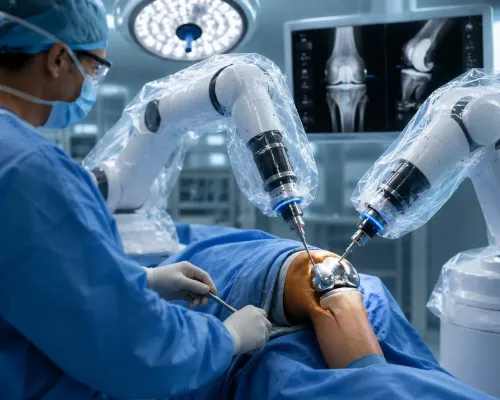
Knee pain can gradually change the way a person walks, climbs stairs, exercises, works, and manages everyday activities. When advanced joint damage no longer responds adequately to non-surgical management, joint replacement may become one of the treatment options considered after an orthopaedic evaluation. Robotic Joint Replacement adds computer-assisted planning and guidance to selected joint replacement procedures, helping the surgeon execute the planned implant positioning with greater precision.
For patients in PCMC and surrounding areas of Maharashtra, understanding what robotic assistance actually does can make conversations about joint replacement clearer.
What Does Robotic Assistance Mean?
The term “robotic” can sometimes create the impression that a machine performs the operation independently. That is not how robotic joint replacement generally works.
The orthopaedic surgeon remains responsible for the procedure. Robotic technology functions as an additional planning and guidance system. Depending on the platform being used, it may help the surgical team assess the patient’s anatomy, plan implant positioning and execute specific parts of the procedure within predetermined parameters.
The technology can support:
- Detailed surgical planning
- Assessment of individual joint anatomy
- Accurate bone preparation
- Planned implant alignment and positioning
- Intraoperative decision-making
- Reproducibility of the surgical plan
The exact benefits and suitability depend on the patient, the affected joint, the implant system and the technology available.
Why Individual Anatomy Matters
Two people with knee arthritis may have very different joint anatomy. Bone shape, deformity, ligament condition, previous injuries and the pattern of cartilage loss can influence surgical planning.
This is one reason joint replacement cannot be approached as an identical procedure for every patient. Robotic systems can provide the surgeon with additional information about the individual joint during planning and surgery.
However, technology is only one component of treatment. The surgeon’s assessment, appropriate patient selection, implant choice, surgical technique and rehabilitation remain important.
Who May Need a Joint Replacement Evaluation?
Persistent symptoms deserve an orthopaedic assessment when they begin limiting normal life. Evaluation may be particularly relevant when someone experiences:
- Significant pain during walking
- Difficulty climbing stairs
- Reduced knee movement
- Pain that affects sleep or routine activities
- Increasing joint stiffness
- Progressive deformity
- Symptoms continuing despite appropriate conservative care
Not every person with knee pain requires surgery. Early or moderate joint problems may be managed through medication, physiotherapy, activity modification, weight management or other appropriate measures.
Making an Informed Decision
At Ayush Orthopaedic Clinic, patients seeking orthopaedic care in PCMC can be assessed according to their symptoms, mobility, clinical findings and imaging before treatment options are discussed.
For people considering robotic joint replacement in the Pimpri Chinchwad region, the important question is not simply whether robotic technology is available. It is whether joint replacement is appropriate in the first place and, if it is, which surgical approach best matches the individual condition.
A detailed orthopaedic evaluation helps separate situations that can still be managed conservatively from advanced joint conditions where replacement may reasonably be considered.
Keywords